Living in Kamla Nagar: Schools, Hospitals & Markets Around Elevate Kamla Nagar
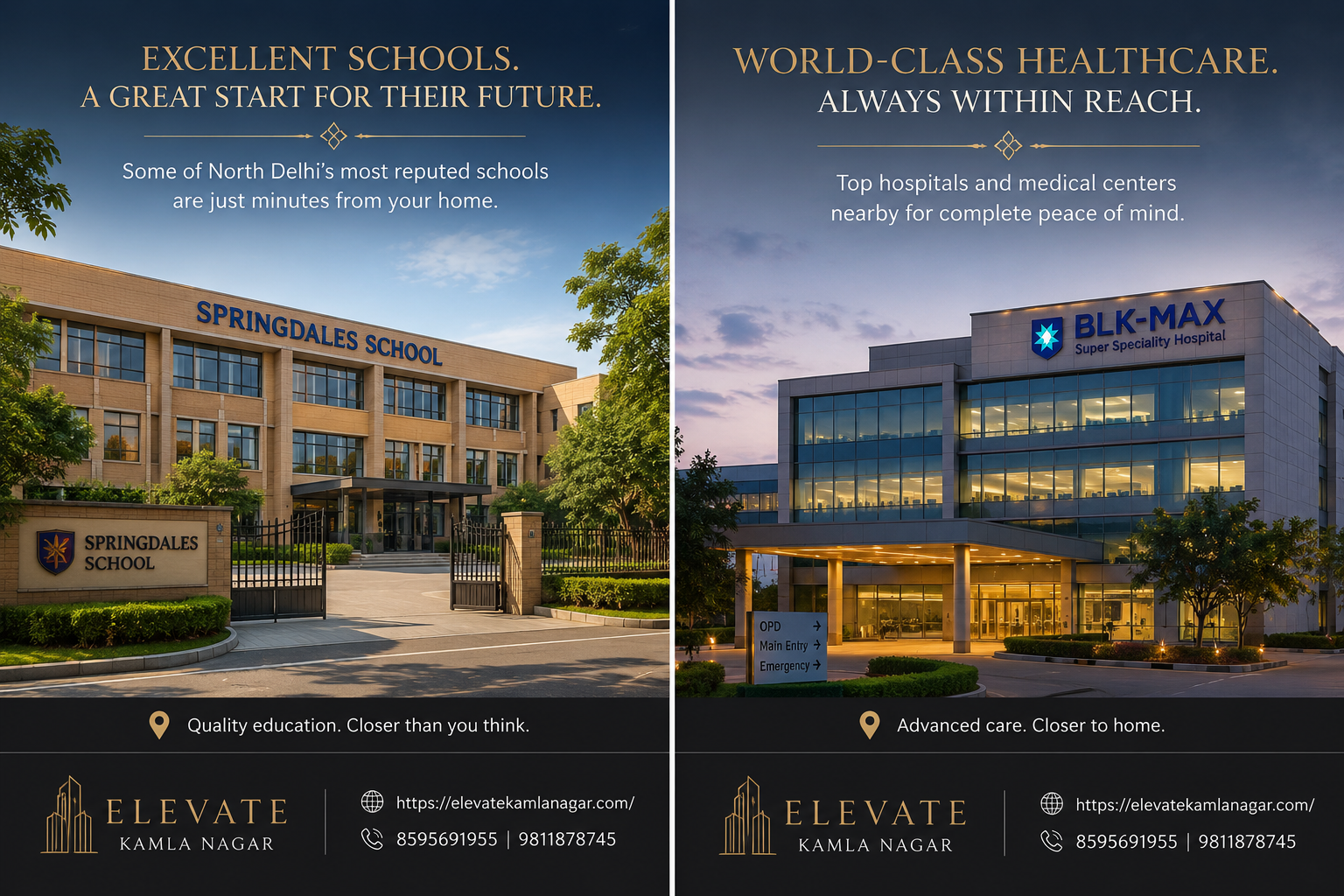
Living in Kamla Nagar — The Schools, Hospitals and Markets Around Elevate
Most new luxury addresses in Delhi have to build their neighbourhood from scratch. Elevate does not. Rising on the ten-acre former Birla Cotton Mills site in Kamla Nagar, North Delhi, the development sits inside one of the capital's oldest planned residential districts — a place that has had schools, hospitals, markets and a university on its doorstep for close to a century. For a buyer, that means the daily infrastructure of family life is already here, tested by generations, rather than promised on a brochure.
This guide covers what actually surrounds the site: where children go to school, where families are treated in an emergency, where the weekly shopping gets done, and how the rest of Delhi is reached.
Quick reference: what's around Elevate Kamla Nagar
| Category | Nearby landmarks | Approx. proximity |
|---|---|---|
| Universities | Delhi University North Campus (Hindu, Ramjas, Hansraj, Kirori Mal, St. Stephen's, Miranda House, SRCC) | ~2–3 km |
| Schools | St. Xavier's (Civil Lines), Lilawati Vidya Mandir (Shakti Nagar), Presentation Convent, Guru Nanak Public School | 5–15 min drive |
| Hospitals | Hindu Rao Hospital (Malka Ganj), St. Stephen's (Tis Hazari), Sant Parmanand (Civil Lines), BLK-Max (Rajendra Place) | 5–25 min drive |
| Markets | Kamla Nagar Market, Model Town Market, Chandni Chowk, Khari Baoli, Sadar Bazar | 5–20 min drive |
| Metro (upcoming) | Ghanta Ghar station, Magenta Line extension (Janakpuri West–RK Ashram) | ~100 m from site; DMRC target late 2027 |
| Metro (current) | Vishwavidyalaya (Yellow), Pulbangash & Shastri Nagar (Red), GTB Nagar (Yellow) | Within ~1.5–3 km |
| Green space | Adjoining 16-acre DDA park, Kamla Nehru Ridge, Roshanara Garden | Adjacent / short drive |
Education: a university district, not just a school run
Kamla Nagar's defining feature is that it grew up around Delhi University's North Campus, roughly two to three kilometres from the site. Hindu College, Ramjas, Hansraj, Kirori Mal, St. Stephen's, Miranda House and SRCC are all within the same academic belt. For families raising children who may one day study at DU — and for faculty who already teach there — living this close to the country's most competitive campus is a genuine, and rare, advantage in Delhi.
Schooling options are equally established. St. Xavier's School on Raj Niwas Marg in Civil Lines is among North Delhi's most sought-after institutions and a short drive from the site. Closer still, Lilawati Vidya Mandir Senior Secondary School and Ravindra Memorial School in adjoining Shakti Nagar serve the immediate neighbourhood, while Presentation Convent Senior Secondary School and Guru Nanak Public School add to the choice within a ten-to-fifteen-minute radius. The area's long-standing culture of coaching centres and libraries — a by-product of the university — means an academic support ecosystem sits alongside the schools themselves.
Healthcare: major hospitals within minutes
Proximity to serious medical care is one of the least glamorous but most important tests of a location, and Kamla Nagar performs strongly on it.
Hindu Rao Hospital, one of North Delhi's largest municipal hospitals with an attached medical college, sits at Malka Ganj on the immediate edge of Kamla Nagar — a critical asset in an emergency. St. Stephen's Hospital near Tis Hazari is a century-old, highly regarded multi-speciality institution a short drive away. In Civil Lines, Sant Parmanand Hospital on Sham Nath Marg offers NABH-accredited super-speciality care, including advanced orthopaedics and robotic surgery. For tertiary and specialist treatment, BLK-Max Super Speciality Hospital at Rajendra Place is reachable within roughly twenty to twenty-five minutes, with the Rohini hospital cluster a little further out. Few Delhi micro-markets place this range of secondary and tertiary care so close to the front gate.
Markets and everyday retail
Kamla Nagar Market is one of Delhi's best-known shopping streets, wrapped around the neighbourhood itself. Its lanes — many named after freedom fighters — run from fashion, footwear and jewellery to books, stationery and a much-loved street-food scene, with Spark Mall anchoring the modern retail end. For residents, it means a full high street is a walk or a two-minute drive away, not a weekend expedition.
Beyond it, everyday and specialist shopping is unusually deep. Model Town Market and the retail along Roshanara Road cover daily needs, while the historic wholesale hubs of Chandni Chowk, Khari Baoli (Asia's largest spice market) and Sadar Bazar lie a short drive south for anything from textiles to festival provisions. Hudson Lane near GTB Nagar has become North Delhi's café and dining strip. The project's own planned Grade-A retail high street will add a curated, contemporary layer of shopping directly within the gates — the one retail format the area has historically lacked.
Green space and heritage on the doorstep
The site adjoins a DDA-maintained park of roughly sixteen acres, giving residents a green frontage most central-Delhi projects can only landscape internally — the ten-acre development and the sixteen-acre park together frame close to twenty-six acres of low-rise, open setting in the middle of North Delhi. A short distance away, the Kamla Nehru Ridge offers walking trails, Flagstaff Tower and the Mutiny Memorial, while the 17th-century Mughal Roshanara Garden and the Tibetan enclave of Majnu Ka Tilla add character within a few kilometres. This is a neighbourhood with layers — a mill legacy, a university, and Mughal-era gardens — rather than a blank parcel on the city's edge.
Connectivity across Delhi
The connectivity story is about to change at the front gate. The Delhi Metro's Phase 4 Magenta Line extension (Janakpuri West–Ramakrishna Ashram Marg) brings a new Ghanta Ghar station roughly 100 metres from the site, alongside the historic clock tower on Grand Trunk Road. DMRC is targeting completion of this underground stretch by late 2027, which would give residents a walk-to-metro on a line that interchanges with the Yellow, Red, Pink, Green and Blue lines and runs down towards the New Delhi Railway Station and Connaught Place core.
Until then, Kamla Nagar is already served on two lines: Vishwavidyalaya and GTB Nagar on the Yellow Line, and Pulbangash and Shastri Nagar on the Red Line, all within a short drive. Connaught Place is reachable by road in roughly 25–30 minutes outside peak hours, and the Grand Trunk Road corridor and Ring Road put the airport, railway stations and ISBT within practical reach.
Why an established location matters
Delhi's newer luxury launches — whether in Karol Bagh, Moti Nagar or Ashok Vihar — are largely competing to create an address. Elevate begins with one already made. The schools, hospitals, university and markets described here were not planned around a project; the project was planned inside a hundred-year-old neighbourhood that already had them. For a family weighing a long-term move, that difference — verifiable social infrastructure versus a location still proving itself — is the quiet argument that a spec sheet cannot make.
Frequently asked questions
Which schools are near Elevate Kamla Nagar? St. Xavier's (Civil Lines), Lilawati Vidya Mandir and Ravindra Memorial (Shakti Nagar), Presentation Convent, and Guru Nanak Public School are all within a short drive, alongside Delhi University's North Campus roughly 2–3 km away.
Which hospitals are closest to Kamla Nagar? Hindu Rao Hospital at Malka Ganj is the nearest major hospital, with St. Stephen's (Tis Hazari), Sant Parmanand (Civil Lines) and BLK-Max (Rajendra Place) all within a 5–25 minute drive.
Where is the nearest market and metro? Kamla Nagar Market surrounds the neighbourhood itself. Vishwavidyalaya and GTB Nagar (Yellow Line) and Pulbangash and Shastri Nagar (Red Line) are all within a short drive today, and a new Ghanta Ghar station on the Phase 4 Magenta Line extension is coming up roughly 100 metres from the site, targeted by DMRC for late 2027.